
For Your Love Only

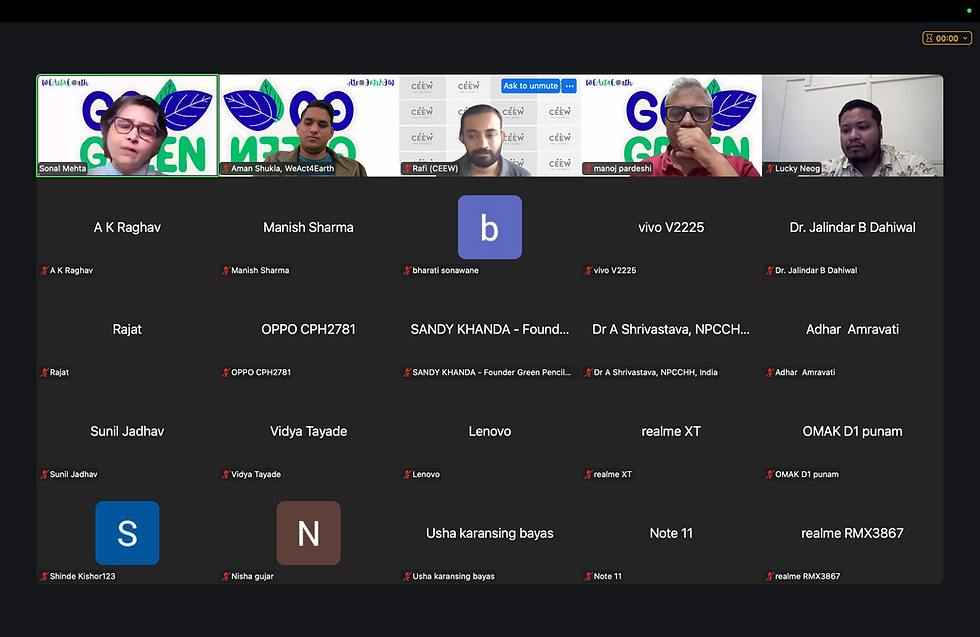
On the eve of Valentine’s Day 2026, WeAct4Earth organised a national-level virtual webinar titled
“For Your Love Only: People-Centred Action for Clean Air and Healthy Lives.” The theme intentionally reframed environmental responsibility as an act of love — love for oneself, communities, and future generations. Clean air was positioned not merely as an
environmental concern, but as a public health necessity, a social justice imperative, and a matter
of equity and dignity.
India continues to face severe air pollution challenges, with significant health burdens including respiratory illnesses, cardiovascular diseases, reduced productivity, and disproportionate impacts
on vulnerable populations. While national and sub-national policies exist, implementation gaps
and limited community participation persist.
This webinar created a platform to bridge evidence, policy dialogue, grassroots experience, and
inclusive climate justice perspectives.
Objectives For Your Love Only
The Webinar aimed to:
Examine long-term health and environmental impacts of Air Pollution in India.
Identify structural and governance gaps in Air Quality Management.
Highlight Community Led and Youth driven climate responses.
Promote intersectional and inclusive environmental justice.
Inspire collective and individual accountability for clean Air.
Outcome Placeholder: This additional objective card visually matches the established style and environmental palette.
The webinar witnessed strong national engagement and representatives across country:
- 509 participants registered
- 250 participants joined live (approximately 49% attendance rate)
Participant Overview
Participants included:
- Representatives from grassroots and marginalised communities
- Public health professionals
- Researchers and academicians
- Policy experts
- Civil society organisations
- Youth and climate advocates
The high registration reflected strong interest in linking environmental issues with public health and equity.
Opening Session
Mr. Manoj Pardeshi, Director, WeAct4Earth, opened the session by underscoring the moral imperative of clean air advocacy. He emphasised the importance of public action and shared the organisation’s vision, objectives, and ongoing work at the intersection of climate and health justice.

“Clean air is not a privilege — it is a fundamental right. Protecting it is an act of love for ourselves and generations to come.” – Mr.
Manoj Pardeshi

Dr. Aakash Shrivastava contextualized air pollution as a critical public health challenge, highlighting its direct impact on respiratory illnesses, cardiovascular diseases, and vulnerable populations. He shared key initiatives undertaken under NPCCHH and emphasized the importance of integrating air quality action within public health systems.
“Air pollution is no longer just an environmental issue; it is a growing public health emergency. Our response must be systemic, coordinated, and people-focused.” – Dr. Aakash Shrivastava, NPCCHH, NCDC
Welcome Address
Opening Remarks by Dr. Aakash Shrivastava, National Program for ClimateChange and Human Health, NationalCentre for Disease Control
He encouraged practical steps such as increased use of public transportation, wearing masksduring high pollution days, and promoting plantation drives. He also highlighted the IEC materialsdeveloped by the department, which can be effectively utilized by CSOs and the public to raiseawareness and drive community-level action to reduce air pollution and address climate change.
Additionally, he urged citizens to:
- Reduce the use of private vehicles and opt for carpooling, cycling, or walking.
- Avoid burning waste and discourage firecrackers.
- Conserve energy by switching off unused appliances and adopting energy-efficient devices.
- Support clean energy solutions and sustainable consumption practices.
- Participate in local environmental campaigns and advocate for cleaner neighbourhood practices.
He emphasised the need for cross-sectoral collaboration under national health and climate
frameworks.
Technical Sessions (Moderated by Aman Shukla)
The technical segment followed a structured progression:
Evidence → Policy Gaps → Community Action → Inclusive Justice
Time has told! – over years Air Pollution in India: Evidence & Trends
Ms. Tanushree Ganguly, Air Pollution Program, University of Chicago
Tanushree presented long-term air quality trends in India, drawing attention to persistent PM2.5 exposure levels across major cities and the measurable decline in life expectancy linked to pollution. She emphasised that:
Scientific data clearly establishes the severity of India’s air pollution crisis.
Monitoring systems have improved, but local action remains inconsistent.
Evidence must directly inform district and city-level decision-making.
She highlighted that while India has begun addressing air quality through national programs, implementation remains uneven across states.


“The evidence is overwhelming — the real challenge now is turning data into decisive action.” Ms. Tanushree Ganguly, University of Chicago
Hamaari Adhuri Kahani - Policy Gaps in Addressing Air Pollution
Mr. Mohammed Raffiuddin, Council on Energy, Environment and Water (CEEW)
Mohammed Raffiuddin examined the structural and governance challenges that continue to hinder effective air quality management in India. Drawing on international examples, he highlighted comparative “before and after” air pollution trends from various countries, demonstrating how well-designed and effectively implemented policies have resulted in measurable improvements in urban air quality. He called for strengthening enforcement mechanisms and enhancing state–city collaboration.
Key Insights
- Fragmented institutional coordination
- Limited technical capacity at the city level
- Weak accountability mechanisms
- Inconsistent monitoring and reporting


“We do not suffer from a lack of policy — we suffer from a lack of implementation, accountability, and sustained political will.” – Mr. Mohd Raffiuddin,CEEW
Saathi haath badhana - People’s Action in Reducing Air Pollution
Community-Led Action
Mr. Sandy Khanda, Green Pencil Foundation:
Sandy shared examples of grassroots mobilisation and youth engagement initiatives. He talk about their local initiatives such as Climate chaupal, eco-friendly library, waste material vertical garden, traditional local skills of bamboo use, etc. He said that if we start with changing things at home and when many people do it things will change. He emphasised that our forefathers were in sync with nature and if we do that too things can slowly change. He emphasised the power of youth-led environmental leadership.
Key Focus Area
- Climate education among young people
- Sustainable lifestyle campaigns
- Community awareness linking health and air quality
- CSR-supported community action

“Real change begins in communities. When young people organise, clean air becomes a movement — not just a policy document.” – Mr. Sandy Khanda, Green Pencil Foundation


Love is universal - Everyone has a role! Inclusive Climate Justice.
Lucky Neog, Founder - Queer-e-Junglers, Queer & Trans-Led Collective on Climate Change. Lucky highlighted the intersection of environmental justice and marginalised identities. He emphasized that identity is one of the important things but we wish to see our presence everywhere.
He explained his constant and regular efforts such as nature walks, creative workshops, short trips, birds watching collective and environmental festivals. He said that if we continue working slowly and steadily things will start changing. This segment reinforced the importance of equity-centred climate leadership.
Key Focus Area
- Environmental advocacy must include queer and trans communities
- Access to nature and clean air is a dignity issue
- Climate justice requires affirming and inclusive spaces


“As a trans person, I have experience judgment and exclusion from people. Yet in nature, I have always found safety, acceptance, and peace. Protecting the environment is deeply personal to me—it is about safeguarding a space that never discriminates.” – Lucky Neog, Queer-e-Junglers
Interactive Q&A
The session allowed participants to engage directly with speakers. Key discussion themes included:
-
Strengthening local governance mechanisms
-
Role of citizen science and community monitoring
-
Youth pathways into climate advocacy
-
Integration of climate and public health strategies
When asked about one immediate national priority for the next 12 months, panelists collectively recommended:
-
Strengthening enforcement of existing policies
-
Enhancing city-level capacity building
-
Expanding public awareness campaigns
-
Institutionalising community participation in air governance
-
Use of Public Transport and Masks
Key Outcomes
✔ Increased awareness of air pollution as a health, equity, and climate issue
✔ Clear articulation of structural and implementation gaps
✔ Strengthened collaboration between research, policy, and grassroots actors
✔ Amplification of youth and marginalised voices in environmental discourse
✔ Renewed commitment to people-centred and inclusive climate action
Conclusion & Way Forward

The session concluded with remarks from
Ms. Sonal Mehta, Managing Director,
WeAct4Earth:
Small exercise was done where people were encouraged to share their wishes for cleaner air.
Once that round was over, starting from panellists, organisers and speakers’ participants were
asked to share one action on the Valentine’s Day that will reflect our love for clean air, for oneself
and for our loved ones. Through a picture, she also reflected that everyone would make a
difference, starting from self. Interesting responses such as going to meet girlfriend without
vehicle, ensuring wearing mask, taking colleague to work in their car, etc were shared.
“If love means care, then caring for the air we breathe is the most fundamental form of self-love
and collective responsibility.”
WeAct4Earth reaffirmed its commitment to:
- Evidence-based advocacy
Multi-sector partnerships
Youth and community leadership
Inclusive environmental governance
Overall Impact
-> With 509 registrations and 250 live participants.
-> The webinar demonstrated strong national
interest in linking environmental sustainability with public health and social justice.
-> The dialogue successfully bridged science, policy critique, grassroots mobilisation, and intersectional climate justice — reinforcing that protecting clean air is not optional, but essential
for a healthy, equitable future.